Methodology
Sharing of Good Practices – Methodology
Analysis of European and African Good Practices
The first activity within the WP7 of SaferAfrica project is to conduct a systematic review of EU and African good practices, highlighting those countries that have adopted successful solutions for different road safety issues and analysing these measures in detail. In addition, critical issues affecting countries will also be analysed. Good practice will be defined in terms of both final outcomes (measured as reductions in casualties or injury severity) and expected outcomes. In all cases, good practices are identified on the basis of clear evidence. The systematic review is framed around identifying road safety measures that map to outcomes identified across 5 distinct pillars plus cross-cutting issues in the African Road Safety Action Plan. These are shown in the table below.
Pillar 1: Road Safety Management 1. Established/strengthened Lead Agencies
2. Improved management of data
3. Developed/strengthened partnership and collaboration
Pillar 2: Safer Roads and Mobility 1. Safer road infrastructure for all road users
2. Capacity building and training
Pillar 3: Safer Vehicles 1. Roadworthiness of vehicles
Pillar 4: Safer Road Users 1. Educated general public (road users)2. Use of helmets
3. Use of seatbelt
4. Drink-driving and driving under the influence of other drugs
5. Use of mobile phone while driving
6. Speeding
Pillar 5: Post-Crash Response 1. Improved emergency care
Crosscutting Issues 1. Rural transport safety
2. Evaluation of the Decade
In order to undertake an evaluation of each example of good practice identified, an evaluation framework has been developed that synthesises information relating to:
- General description including the road safety intervention category (taken from the Supreme European project)
- Focus of the intervention such as a type of accident, road user type, duration and mechanism of intervention deployment
- Size of the problem tackled
- Type of expected effects
- Assessed reported effects
- Costs
- Acceptance – who needs to engage
- Sustainability
- References to supporting documentation
The process for undertaking the systematic review is illustrated below.
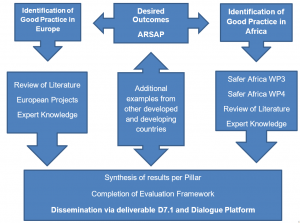
Process for analysis of good practice
Transferability Audit
The basis for the transferability audit comes from the method used in the SaferBrain project - Innovative guidelines and tools for vulnerable road users’ safety in India and Brazil. The process (outlined by Persia et al, 2011) follows the three basic steps.
STEP A – Collecting road safety concepts to transfer (the lesson from Europe, Africa and elsewhere)
A number of interventions will be identified from the Analysis of good practices; this could be practices from outside of African to within Africa or existing practices from an African country to other African countries. The premise will be to identify a selection of road safety issues per pillar and within each issue identify a number of interventions/measures that could address this issue.
STEP B – Creating an Audit tool
The tool to analyze transferability is a Problem Priority Matrix (PPM) in which relationships among rows and columns are scored and weighted by selected experts, so as to identify which measures would be best placed to address safety issues at country level within Africa. In the Saferafrica’s PPM, rows represent safety concepts-inputs and columns the three Road Safety Space factors - Society, Economy, and Institution (King, 2005).
Each country will evaluate measures relating to only those issues that are of prevalence in their country. More than one expert will be approached per country in order to achieve a balanced viewpoint.
STEP C – Assessing the matrix outcomes
Final scores and a list of problems arisen from the Problems Priority Matrix will be finally assessed.
The audit will then be undertaken in two parallel phases:
Phase 1 – Targeted and guided deployment at 5 countries identified for special consideration elsewhere in the SaferAfrica Project. These countries are:
• Burkina Faso
• Cameroon
• Kenya
• South-Africa
• Tunisia
Phase 2 – Use of the dialogue platform for the dissemination of information and inviting comment and contribution from stakeholders across Africa. This will be realised through a number of ‘road safety issue’ fact sheets presenting a range of measures for consideration at a local level.
References
- African Road Safety Action Plan 2011-2020 available at https://www.uneca.org/sites/default/files/PageAttachments/decade_of_action_for_road_safety_2011-2020_en.doc.pdf
- King M. J. (2005). Case studies of the transfer of road safety knowledge and expertise from Western countries to Thailand and Vietnam, using an ecological ‘road safety space’ model: Elephants in traffic and rice cooker helmet. Doctoral thesis, Queensland University of Technology.
- Persia et al. (2011) TRANSFERABILITY OF EU METHODOLOGIES AND TOOLS FOR VULNERABLE ROAD USER SAFETY TO EMERGING ECONOMIES 3rd International Conference on Road Safety and Simulation, September 14-16, 2011, Indianapolis, USA
- Supreme 2007 available at: https://ec.europa.eu/transport/road_safety/sites/roadsafety/files/pdf/projects/supreme.pdf
 SaferAfrica